Ocean House
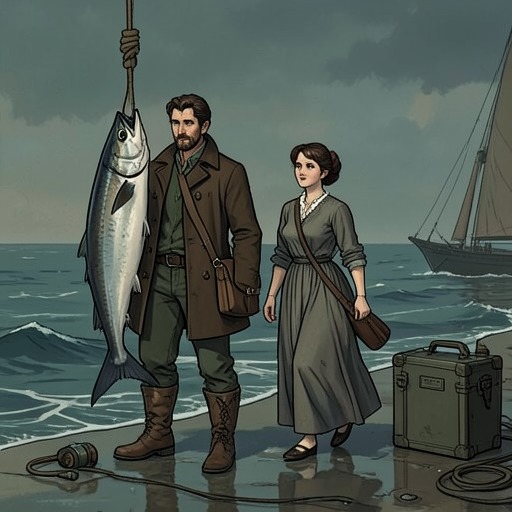
Washington BlackOcean House is a permanent exhibition of aquatic life proposed by Washington Black and established in London with the support of G. M. Goff and Tanna Goff. It gives Washington’s idea a public home and a purpose beyond his earlier work on the Cloud-cutter, but its history is also marked by the likely erasure of his contribution: the exhibition can bear his vision without bearing his name.
Origin and Design
Washington proposes an exhibition that would replace static display with a living environment. He imagines a large hall filled with enormous tanks of aquatic creatures, alongside open-air terrariums for amphibians and reptiles, so visitors could observe animals at close range and learn their habits firsthand. He pictures something permanent, like an indoor park. Tanna recognizes the conception as a sea menagerie; G. M. Goff is initially doubtful, but the proposal catches his interest.
The idea is Washington’s, but its path to institutional approval runs through Goff. Before leaving for London, Goff presents their proposal for a permanent aquatic-life exhibition to the Zoological Committee. The committee accepts it enthusiastically, offers land, and authorizes the conversion of an existing timber building in the zoological gardens. The planned institution is named Ocean House, with an anticipated public opening the following year.
The Building and Its Public Purpose
The site is a tall, narrow wooden building in a grove of black poplars, on a slope within the zoological gardens. Its condition records an earlier disaster: the left wing had exploded at night, reportedly because of an overturned candle, and reconstruction took months. Completed only the year before Washington arrives, that wing remains visibly distinct, its pale timber set against the older, weathered boards. The repaired structure gives the project a usable home, but its history of damage remains legible in the building itself.
For Washington, the institution’s promise lies in making unfamiliar aquatic life available to direct observation. At Ocean House, tanks hold Aesop prawns, molluscs, crabs, sea worms, and polyps; a display of velvet fiddlers occupies a corner. The exhibition is intended to let visitors look closely at creatures they may regard as frightening and discover their beauty instead. Its purpose is not only to display specimens but to change how they are seen.
Washington’s Work and the Question of Credit
The establishment of Ocean House marks a turning point in Washington’s sense of authorship. The Cloud-cutter had demanded his labor, but he understands it as Titch’s vision. Ocean House, by contrast, begins with an idea he can call his own, and its acceptance makes that idea tangible. The project offers the possibility of leaving a mark after a life shaped by expectations of toil and obliteration.
That possibility is qualified from the beginning. Washington expects the institution’s history to celebrate Goff as its founder rather than a young Black man with facial disfigurement and no formal scientific training. He does not describe Goff as simply dishonest: Goff does not, in principle, want to claim Washington’s discoveries, but he is older and eager for a late success. Washington also understands the structural obstacle. He doubts that the committee would receive him as an equal or that he could approach it alone and be taken seriously. The problem of credit therefore belongs both to individual ambition and to the unequal conditions under which the project is presented.
The tension becomes concrete in the exhibition’s finished arrangements. Washington sees his work in the tanks’ size and materials, in the selection of specimens, and even in the placement of aquatic plants. He remembers the calculations, late nights, and mistakes behind those decisions, while recognizing that his name will not appear in the institution’s public account. Pride in what Ocean House has become coexists with anguish at being absent from the story of its making. He considers whether he can accept that loss or must leave the enterprise and the people connected with it.
Development, Departure, and Return
Ocean House continues to develop through practical work as well as its original exhibition plan. When Washington and Tanna return with a two-headed creature, Goff’s astonishment at its appearance gives way to discussion of preserving and displaying it. They test methods suggested by Visser and consider whether the creature could become a centrepiece if the octopus brought from Nova Scotia does not recover. Goff also describes a marine zoologist in Marrakesh who has written about a rare squid and maps out where the man might be found. The London institution thus remains connected to further collecting and display, while Washington’s concern about who directs and receives recognition for the work persists.
During Washington’s later desert journey with Titch, Ocean House returns in a dream as an altered building: not the modest timber structure rebuilt after a fire, but a vast glass greenhouse reflecting trees and filled with light. The vision places the institution within a memory-laden landscape and brings Big Kit into the same dream, calm and present beside Washington. When Washington and Tanna speak of the distance of England and of Ocean House, it seems to belong to another life. Yet the project is not finished for him. Speaking with Titch about what he hopes Ocean House will become, Washington recognizes that he intends to return to London and fight to have his name restored to the account of its creation. Titch listens with interest and calls the project astonishing, but Washington’s resolve to seek credit is his own.
Significance
Ocean House joins scientific observation to a question of power: who chooses what the public sees, how living creatures are presented, and whose labor becomes visible in the finished institution. Washington’s proposal seeks to replace distance and fear with close observation, inviting visitors to learn animals’ habits rather than simply regard them as curiosities. The exhibition’s own making, however, exposes a contradiction. Washington’s detailed work shapes its tanks, collections, and displays, while the expected public recognition belongs to Goff.
The building’s repaired wing offers a material counterpoint to this uneven history. A damaged structure can be rebuilt, and a visionary proposal can become an institution, yet the restoration of the place does not itself restore the name of its principal inventor. Ocean House therefore stands both as Washington’s achievement and as an unfinished claim: its public purpose is to make overlooked forms of life visible, while its own history risks making its creator invisible.